Homer's Odyssey
TELEMACHUS SETS SAIL
“You should be ashamed yourselves,
mortified in the face of neighbors living round about! Fear the gods’ wrath – before they wheel in outrage and
make these crimes recoil on your heads.”
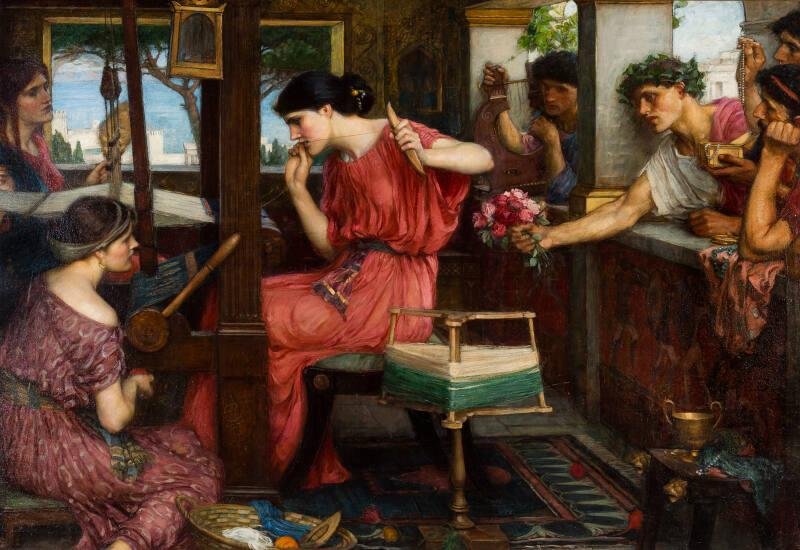
Art: Penelope and the Suitors by John William Waterhouse, 1911-1912, via @AbdnArtMuseums, Aberdeen.
Before we chat about Book 2, turn back to Book 1 and look for the middle. It’s when Athena declares to Telemachus that Odysseus is still alive.
This is the news Telemachus has been waiting for, and it changes everything. Everything that follows is a chain of actions and reactions to that moment.
At the beginning of Book 2, Telemachus awakes the next morning, and he is no longer the same boy we met at the beginning of Book 1. He dresses, dons his sword, grabs his spear, and calls an assembly.
Two hounds flank him as he arrives for the meeting. Notice how he has moved from passive to active? Instead of bemoaning the suitors, he is doing something about them by stepping into his power as his father’s heir.
“Fear the gods’ wrath!” He exclaims.
Telemachus tells the suitors they should be ashamed of themselves. But the battle is not easily won. They push back.
“You want to blame us?” they retort. “What about your mother?”
For years, Penelope has been weaving a funeral shroud for old Laertes, Odysseus’s father. But every night, she undoes her weaving. This ruse marks her as Odysseus’s true match: a woman as shrewd and cunning as her husband. (Was this Athena’s plan as well? Perhaps. She is, after all, the goddess of weaving.)
It’s a touching detail. Penelope is the steadfast picture of loyalty and hope. She believes that Odysseus lives. And she’s holding on to the kingdom by a literal thread until he returns. In every way, she is the opposite of Clytemnestra.
Two eagles appear in the sky—a sign from the gods, prophesying Odysseus’s return, but the suitors laugh it off. Early audiences would have remembered another prophecy that no one believed: made by Cassandra, who warned her fellow Trojans not to bring the wooden horse into the city. The suitors could leave at this point. But when they mock the sign sent by the gods themselves, they seal their fate.
And late that night, in the darkness, Telemachus sets sail with Athena, his guardian goddess still in disguise, “in the pilot’s seat.”
-
Read the Odyssey online in the translation by Robert Fagles, or order the paperback.
Watch another background video on the possible science behind the myths of the Odyssey, from TED Ed.
Disclaimer: As an Amazon Associate, we earn from qualifying purchases. Amazon and the Amazon logo are trademarks of Amazon.com, Inc. or its affiliates.