Homer's Odyssey
CALYPSO SETS ODYSSEUS FREE
“Odysseus shall return and pay the traitors back. Telemachus? Sail him home with all your skill.”
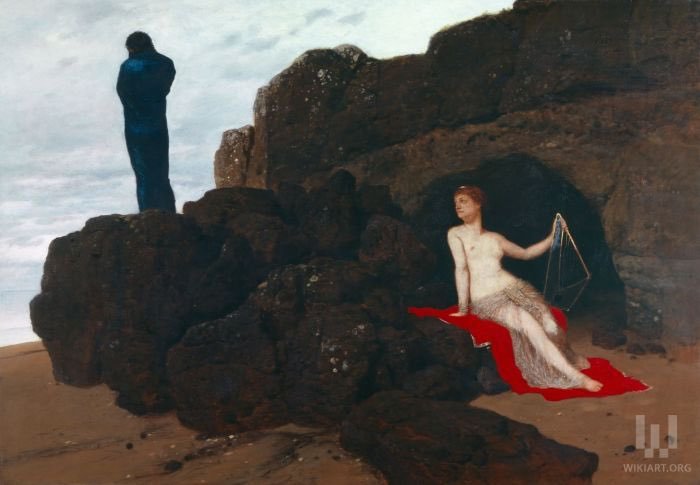
Art: Odysseus and Calypso, by Arnold Böcklin, 1882, via @kunstmuseumbs, Basel.
When Zeus speaks at the council of gods in the beginning of Book 5, the story has come full circle. The message is clear: Odysseus shall return. The suitors will face a reckoning. And Telemachus will return to Ithaca.
Athena has achieved her goal.
Zeus sends Hermes to announce to Calypso that she must release Odysseus. Although she is not happy about this, she has no choice but to obey. She sets out to find the man we have heard so much about.
In some ways, the scene is anti-climactic—but that’s the point. We meet Odysseus not as the once-great warrior, not as the great teller of tales, but as he sits on a rock overlooking the ocean, weeping for his family and home.
Broken.
Diminished.
This is what war does to men.
Now, he is essentially Calypso’s slave. Promised immortality, but separated from everything he holds dear. Is it any wonder he does not trust the gods?
When he learns of his freedom, he builds a raft without delay and sets sail… free at last. But Poseidon is not fooled so easily:
“Outrageous! Look how the gods have changed their minds about Odysseus. […] Still my hopes ride high — I’ll give that man his swamping fill of trouble!”
The sea god sends forth a great storm. When the nymph Ino comes to Odysseus’s aid, he does not trust her and relies instead on his own cunning, (Although he does hedge his bets by hanging onto her scarf.)
By the end of Book 5, Odysseus has been brought as low as a man possibly can be. Naked and broken, he beds down between two olive trees—Athena’s tree—and covers himself with dead leaves.
Come morning, he will rise again.
The presence of the olive trees here symbolize Athena’s victory over Poseidon. According to Greek mythology, Athena won patronage of Athens by gifting the first olive tree to its citizens, symbolizing peace, prosperity, and wisdom. Her gift defeated Poseidon’s saltwater spring. Planted on the Acropolis, the olive tree offered food, oil, and wood.
Here, at Odysseus’s lowest point, Homer plants a quiet promise.
The olive trees do more than shelter Odysseus from the cold. They root him in Athena’s protection. Just as her olive once triumphed over Poseidon’s brine, wisdom and endurance now stand against rage and chaos. The sea may batter him; the gods may test him; but he lies cradled in the emblem of the goddess who has never abandoned him.
Covered in leaves, like a seed pressed into the earth, Odysseus is not finished. He is being planted.
Stripped of armor, of ship, of companions, even of clothing, he has been reduced to the simplest version of himself: a man who wants to go home. And that, Homer suggests, is enough. Odysseus sleeps among the olive branches not as a defeated hero, but as a man on the verge of renewal.
Morning will come.
And with it, the long road home begins again.
-
Read the Odyssey online in the translation by Robert Fagles, or order the paperback.
Learn about the longstanding rivalry between Athena and Poseidon, who compete for the naming of the city of Athens.
Disclaimer: As an Amazon Associate, we earn from qualifying purchases. Amazon and the Amazon logo are trademarks of Amazon.com, Inc. or its affiliates.