Homer's Odyssey
A TIGHTLY WOUND CLIFFHANGER
“Why has my child gone and left me?... Does he want his very name wiped off the earth?”
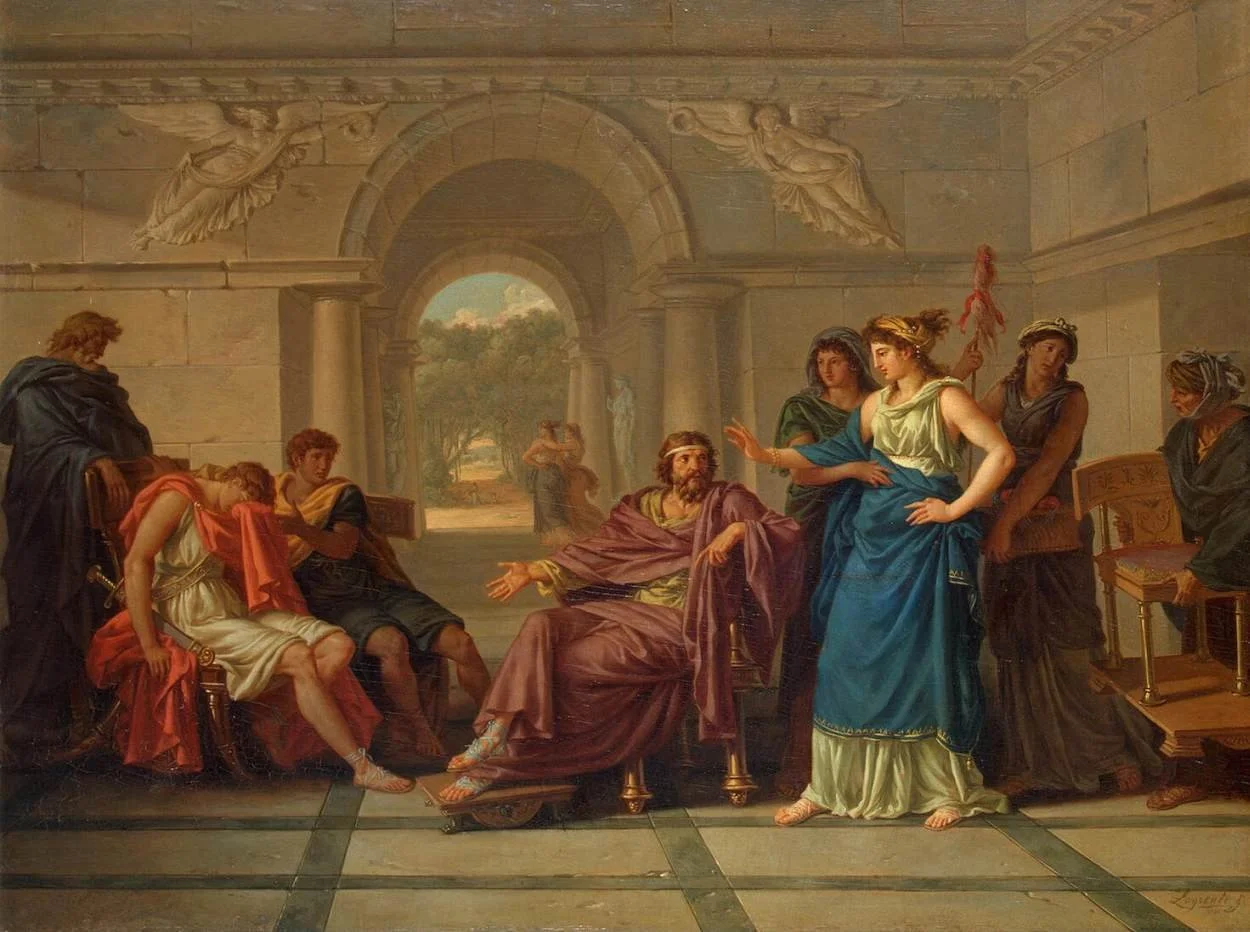
Art: Helen Recognizing Telemachus, Son of Odysseus by Jean-Jacques Lagrenée, 1795.
Book 4 is jam-packed with action and twists and turns, as each storyline (or thread, if we want to lean into a weaving metaphor) converges.
The scene cuts back and forth in rapid succession from Telemachus to his mother in Ithaca. The pace is accelerating.
Menelaus and Helen of Sparta receive Telemachus and Pisistratus, affording us a new trip into the memory of Troy. Helen’s abduction was once at the root of the conflict that has cost Greece so dearly. Now, we find her at home once again with her husband, condemning the foolish choices she made under the influence of Aphrodite, goddess of love.
It’s enough to wonder if the whole war wasn’t an entire waste and madness, spurred on solely by the envy and rivalry of three goddesses vying to be the most beautiful. (If you’re not familiar with the golden apple of discord, marked “for the fairest,” look up the Judgment of Paris and watch this video.)
The visit is the occasion of more storytelling. This time, we hear first-hand how Odysseus tricked the Trojans with the great horse, securing victory for the Greeks. Menelaus also shares that, like Odysseus, he was trapped on an island on his way home, until he managed to capture the Old Man of the Sea. What’s all that about?
For twenty days, Menelaus was stranded on the island of Pharos, and instructed by the goddess Eidothea to lie in wait for Proteus, the Old Man of the Sea, who naps among his seals every day at noon. Capturing Proteus was no small feat: as a shapeshifter, he turned into a lion, snake, leopard, pig, water, and even a tree. But Menelaus held on. Once captured, Proteus revealed that Menelaus needed to make sacrifices to the gods in Egypt to gain favorable winds. He also told him that Agamemnon had been murdered, and that Odysseus was trapped on Calypso’s island.
This is the confirmation Telemachus has been waiting for.
We cut back to Odysseus’s palace in Ithaca, where the suitors are finally realizing that Telemachus has not snuck off somewhere with the sheep and goats, but has sailed away for news of his father.
They agree to set sail and lay in wait for him, to murder him upon his return—a twisted and perverted echo to the story of Agamemnon and Orestes. But in The Odyssey, it is the would-be fathers-in-law who await the son and true heir in order to murder him.
Penelope, who learns that Telemachus has indeed set sail, is overcome with grief. But Athena has not forgotten Penelope, either. She sends a phantom in the likeness of Iphthime, Penelope’s sister, to comfort the queen as she sleeps. The dream-vision reassures her that Telemachus will return safely and that the gods are with her.
As Book 4 ends and we prepare to meet Odysseus on Calypso’s island, each thread of the story is tightly wound. It’s a cliffhanger.
And now, the stage is set.
-
Read the Odyssey online in the translation by Robert Fagles, or order the paperback.
Learn about the Judgment of Paris that resulted in the Trojan War.
Disclaimer: As an Amazon Associate, we earn from qualifying purchases. Amazon and the Amazon logo are trademarks of Amazon.com, Inc. or its affiliates.