Homer's Odyssey
THE CYCLOPS
“Cyclops – if any man on the face of the earth should ask you who blinded you, shamed you so – say Odysseus, raider of cities, he gouged out your eye, Laertes' son who makes his home in Ithaca!”
Art: Odysseus in the Cave of Polyphemus, by Jacob Jordaens, 1593-1678 via @mfaboston, Boston.
The hall falls silent as Odysseus tells his own story.
He reveals how he survived, and why he has not been able to go home.
First, the victories. After his men sack the city of the Cicones, they land on the island of the Lotus Eaters, where some of his crew are robbed of memory. They forget not only home but who they are, until Odysseus drags them back to their ships by force.
But the greatest danger lies ahead.
They land safely on the island of the Cyclopes. They replenish their supplies and could go on their way, but curiosity gets the better of Odysseus. That’s when he enters the cave of Polyphemus and he and his men help themselves to the Cyclops’s food.
In this moment, they resemble the suitors back in Ithaca, men who make a mockery of hospitality by invading another man’s home and devour what is not theirs. Here, Odysseus commits a similar offense.
It is one of Homer’s most insightful details because it reminds us that heroes are not morally simple.
When Polyphemus returns, the illusion of safety shatters. The giant blocks the entrance with a stone too large for any man to move. His plan? To eat them all, one by one.
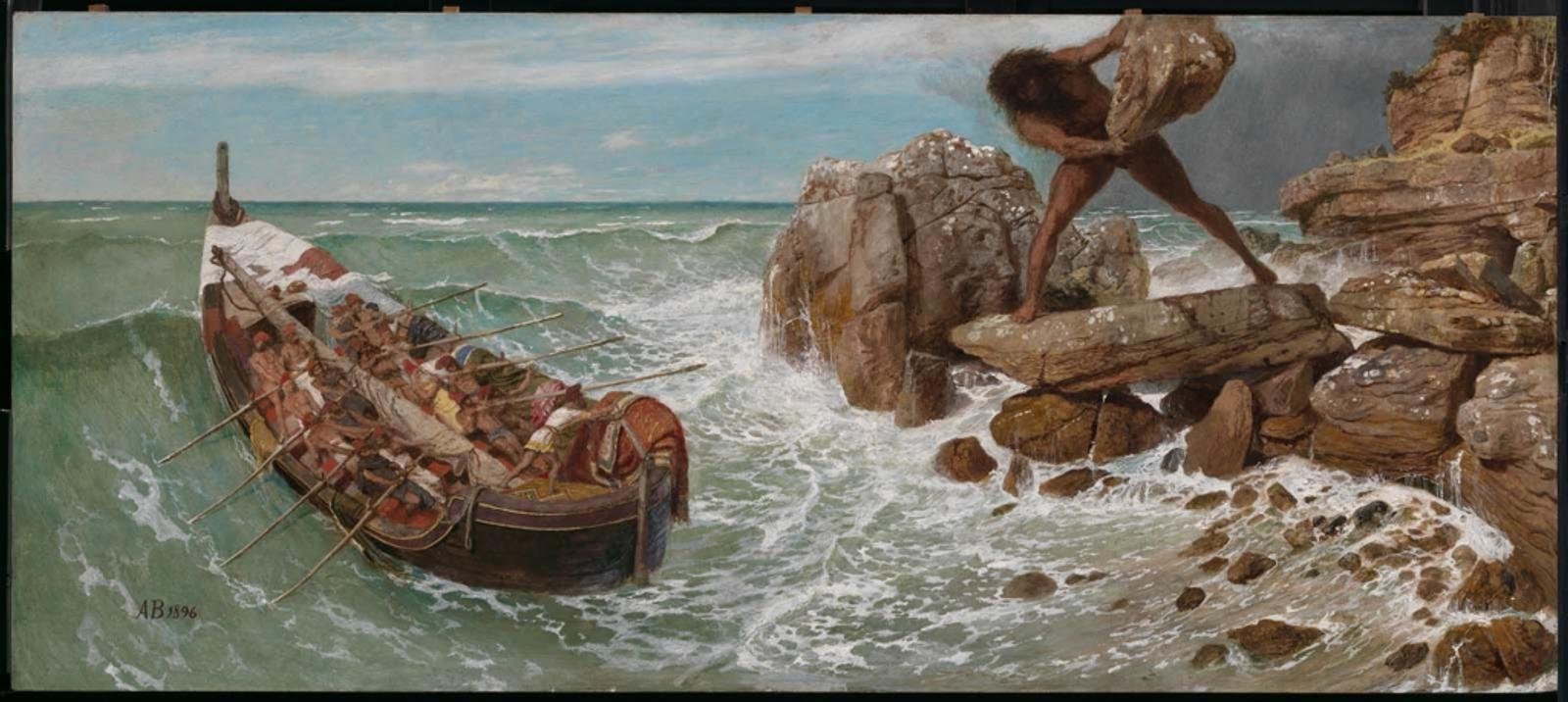
Odysseus must now solve a problem entirely of his own making. His strength cannot save him: he can only hope to outwit the monster. He plies the Cyclops with wine and waits for him to fall asleep. That’s when he and his men drive a stake into the Cyclops’s eye and blind him. It is a brutal and cruel solution in response to life-and-death stakes.
But Odysseus’s greatest act of cleverness is his way with words.
When Polyphemus asked his name, Odysseus replied, “Nobody.” So when the Cyclops cries out in agony and calls for help, he tells the other Cyclopes:
“Nobody is killing me!”
And, confused, they leave him to suffer.
Although the monster outmatches Odysseus in strength, he outmatches Polyphemus in wit.
If the story ended here, Odysseus would be home by now.
But it doesn’t.
Once he escapes, instead of preserving his anonymity, Odysseus makes a different choice. He speaks his name, because he wants to be remembered as somebody: as Odysseus, the great hero. He shouts across the sea:
“If anyone asks who blinded you, tell them it was Odysseus, raider of cities, king of Ithaca!”
This is the most dangerous moment in the entire epic. Under the sway of great hubris, Odysseus cannot contain himself. And Polyphemus immediately claims the advantage. He calls upon his father, Poseidon, god of the sea, and asks for one thing in revenge:
Let Odysseus never reach home. Or, if he does, let him arrive late, alone, a broken man, and having lost everything.
Poseidon answers. That is why Odysseus’s journey has lasted ten years.
Odysseus escaped the monster, but he could not get out of his own way.
Sometimes, the greatest victory is letting go of the need to be known. Odysseus has learned that lesson the hard way.
-
Read the Odyssey online in the translation by Robert Fagles, or order the paperback.
What do Polyphemus, dwarf elephants, and Tolkien’s Lord of the Rings have in common? Find out!
Disclaimer: As an Amazon Associate, we earn from qualifying purchases. Amazon and the Amazon logo are trademarks of Amazon.com, Inc. or its affiliates.