Homer's Odyssey
LAND AND LINEAGE
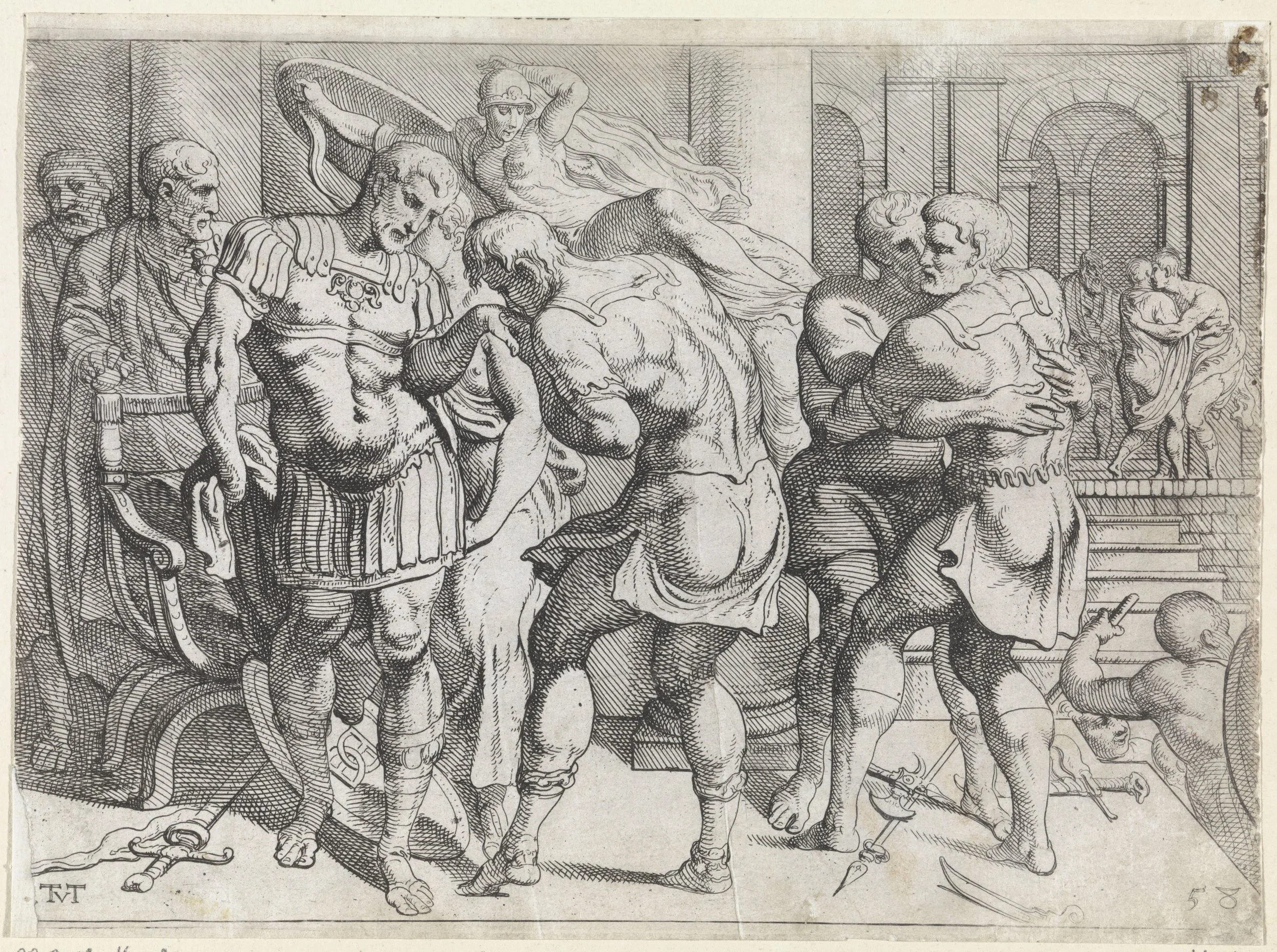
“Living proof — and Laertes' knees went slack, his heart surrendered, recognizing the strong clear signs Odysseus offered. He threw his arms around his own dear son, fainting as hardy great Odysseus hugged him to his heart until he regained his breath, came back to life…”
Art: Verzoening tussen Odysseus en de Ithacaanse rebellen by Theodoor van Thulden after painting by Francesco Primaticcio, 1632-1633 via @rijksmuseum, Amsterdam.
The story does not end with the shedding of blood. True restoration demands the healing of the past and securing of the future.
Odysseus travels to the outskirts of the kingdom to find his father, Laertes, in a garden, dressed in rags and mourning his lost son.
In a mirror of Penelope’s test, Laertes does not immediately believe this man is Odysseus. To prove his identity, Odysseus points to the trees in the orchard. He recounts how, as a small boy, his father gave him those very trees: thirteen pear trees, ten apple trees, and forty fig trees.
Here, identity is tied to what was planted and nurtured long ago. By remembering the trees of his childhood, Odysseus proves that in addition to a king returning to power, he is a son returning to his roots.
As father and son reunite in Ithaca, the scene shifts briefly to the Underworld, where Hermes leads the shades of the suitors down into the dark. There, they encounter the shade of Agamemnon.
Remember the warning from Book 1? Agamemnon’s homecoming was a bloodbath of betrayal. He asks the suitors how they died and they attempt to blame Penelope. Even now, in death, they exhibit no accountability for their actions.
When Agammemnon hears of Penelope’s loyalty, he offers a final word of admiration and praise for Odysseus’s worthy wife, recognizing her as the Anti-Clytemnestra.
The families of the suitors come for revenge, and for a moment, it looks like Ithaca will be consumed by civil war. But Athena descends, and with a thundering voice commands everyone to put an end to bloody war. The time for peace has come.
The Odyssey ends with a beginning. As peace settles over the olive groves of Ithaca, the stage is set for the next movement in the Western tradition. The image of Odysseus standing with his elderly father reminds us of what is to come in Virgil's Aeneid: the hero Aeneas carrying his aged father, Anchises, on his back out of the flames of Troy.
To read the Odyssey is to join a conversation that has been going on for nearly three thousand years. It is a story that insists that no matter how far we wander, and no matter how many monsters we face, the journey toward character, home, and rightful identity is one worth taking.
-
Read the Odyssey online in the translation by Robert Fagles, or order the paperback.
Watch this video to learn more about Laertes.
Disclaimer: As an Amazon Associate, we earn from qualifying purchases. Amazon and the Amazon logo are trademarks of Amazon.com, Inc. or its affiliates.