Plato’s Apology
Alongside Plato, witness the trial and, ultimately, the death of Socrates in the Apology with Dr. Caleb Simone. Consider timeless questions such as:
What makes life worth living?
What are you willing to die for?
What does it mean to live according to your values?
This free edumedia™ reading journey will help unlock insights from Plato’s reflection on the death of his mentor to transform your own life.
-
While Socrates, the celebrated Athenian philosopher (470-399 BC), left behind no writings of his own, he’s a main character in nearly all of the “dialogues” his student Plato wrote. Socrates had a reputation for strolling the town center, questioning Athenians of all walks of life and the cultural ideas they blindly followed. In his relentless pursuit of truth and self-knowledge, Socrates often exposed the reputations of those around him. So much so that his fellow citizens brought charges against him for which he was convicted and sentenced to death by a jury of around 500 peers.
Plato’s Apology of Socrates presents itself as a version of the historical speech that Socrates gave in his own defense at his trial. Other authors, too, such as Xenophon, wrote their own versions, but none have been so influential as Plato’s. Regardless of its literal accuracy, Plato’s Apology memorably encapsulates the life that Socrates lived and the conviction for which he died, catalyzing a movement that would inspire numerous philosophical schools of thought. Plato’s version distills this movement into Socrates’ most well-known line from the speech: “The unexamined life is not worth living.”
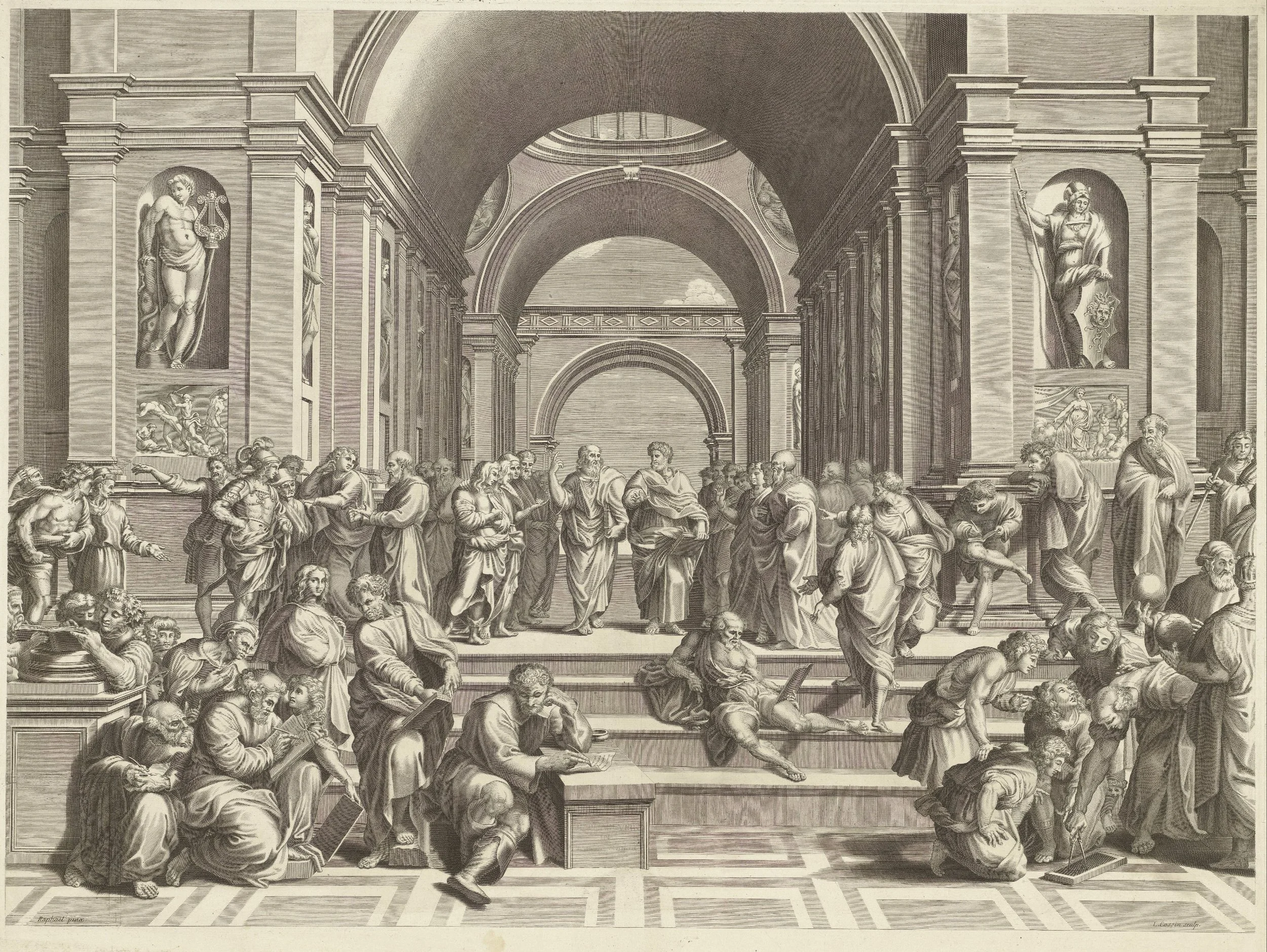
School van Athene, print made by Louis Cossin after painting by Rafaël (1637-1686) from the Rijksmuseum
-
Text: 17a-24a
“Chaerephon went to Delphi once and ventured to ask the oracle… if any man was wiser than I, and the Pythian replied that no one was wiser.” (21a)
From the start of his defense, Socrates points out that he must not only defend himself against the actual charges brought against him, but that he must first respond to an earlier, more insidious slander that led to the official charges. At the age of seventy, Socrates addresses a jury of mostly younger Athenian citizens who, he argues, have been poisoned against him since their childhood by public rumors that Socrates is a busy-body and a “sophist,” someone who professed to teach exclusive skills. Socrates singles out the comic poet Aristophanes, who portrayed Socrates as a quack intellectual who charges fees to corrupt his young disciples. Socrates challenges his audience to name a single instance of when anyone heard him speaking about such things or charging people money in exchange for wisdom.
Socrates goes on to explain that this slandered reputation arose long ago, after a friend named Chaerephon went to Apollo’s oracle at Delphi to ask, “Is anyone wiser than Socrates?” The Pythian priestess responded, “No one is wiser.” Socrates then made it his mission to discover what the oracle meant; he knew he was not wise, but he also knew that the oracle must not be false. Socrates went on to examine a respected public figure, certain that this celebrity would be wiser than himself. But on questioning him, Socrates found that this public figure actually was not wise–he only professed to be wise. Socrates goes on to find that the same was true of poets and craftsmen: they profess wisdom and think themselves wise, but Socrates finds greater wisdom in other, humbler sources. Perhaps–Socrates reasons–he is the wisest of all, simply because he does not pretend to know things that he does not. But just as Socrates’ self-understanding grew, his social standing began to rupture. While testing the oracle’s claim about his wisdom, Socrates exposes and infuriates several prominent Athenians. In the process, he captures the attention and admiration of several young Athenians who try to imitate Socrates’ style of questioning, further enraging the men of power and influence in Athens.
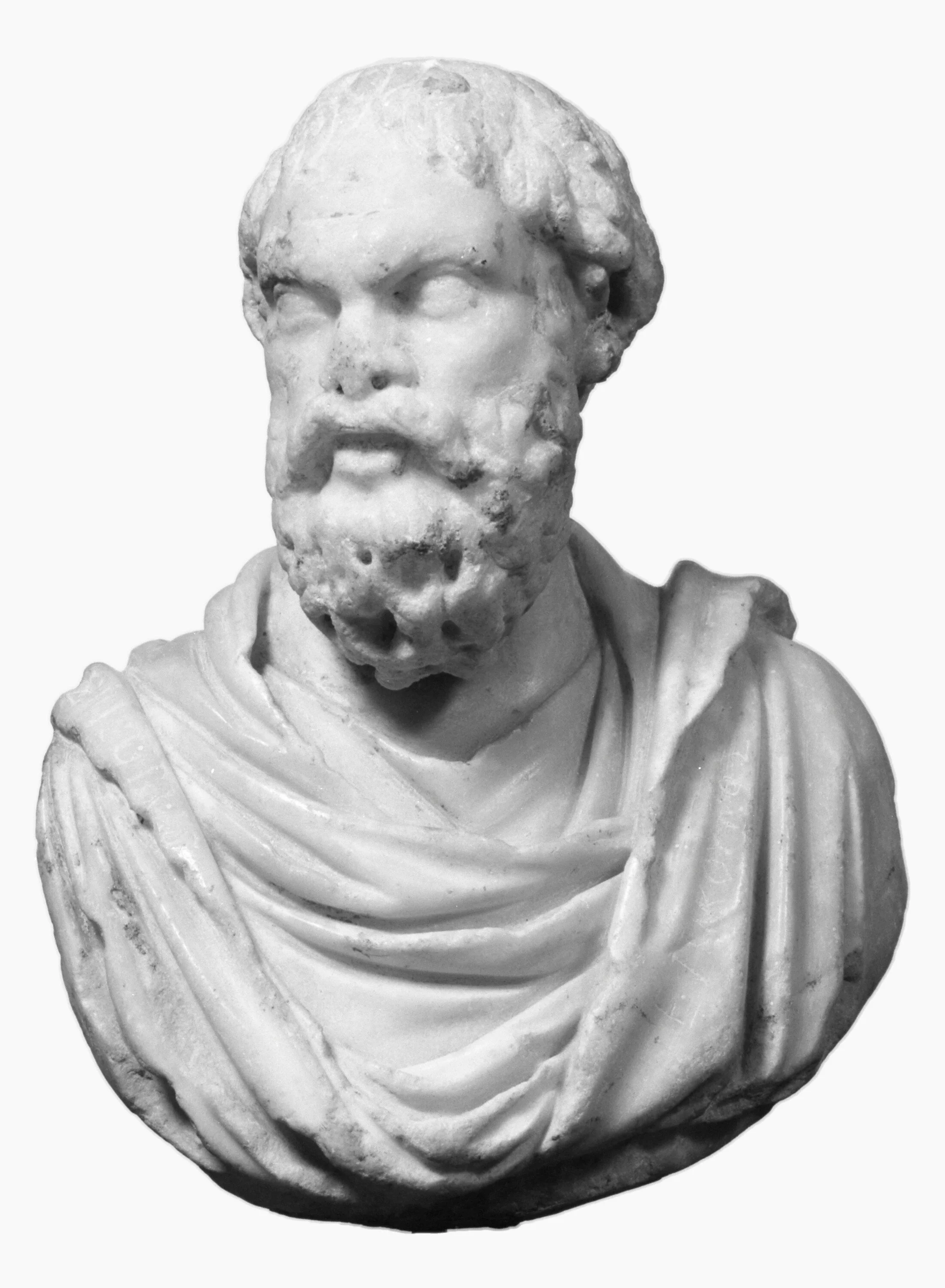
Head of Socrates (on Eighteenth-Century Bust) from The Getty Museum
-
Text: 24b-28a
After explaining how Athenian public sentiment had been turned against him, Socrates goes on to defend himself against his formal accusers. Three prosecutors brought the trial against Socrates: the poet Meletus was the wordsmith leading the case; the wealthy democratic leader, Anytus, was the political force behind the trial; and Lycon, an otherwise unknown orator, was reported by later sources to be a “rabble-rousing” demagogue stoking public enmity toward Socrates. While their motives against Socrates are not clearly stated in ancient sources, Anytus was especially opposed to “sophists,” public speaking teachers who, according to democracy’s defenders, taught persuasion as a tool for manipulating public discourse.
Socrates begins with their official affidavit: “Socrates is guilty of corrupting the young and of not believing in the gods that the city reveres, but believing in other, new spiritual beings” (24b). To casual listeners and bystanders, Socrates’ intense method of questioning his fellow citizens in public surely seemed counter-cultural: it enraged his fellow citizens and attracted young people to this rigorous way of engaging the world. Socrates takes the opportunity to “cross-examine” his accusers in his distinctive style. He traps Meletus in his own words and raises the question: if you are so certain that Socrates corrupts the young people, who makes them better? For that matter, what makes society better at all, and is it something human beings can truly know and teach to one another?
Meletus replies with only the most cursory of answers, allowing Socrates to show that these accusers have thought very little about morality and the future of Athens. They are simply united in their enmity toward Socrates. In the same way, Socrates goes on to show how their formal accusation is a contraction in terms: “By saying that I do not believe in the gods, do you mean that I am an atheist and do not believe in gods at all?” Socrates asks. “Exactly,” Meletus confirms. “Then how can you say I believe in ‘other, new spiritual beings’ if you first call me atheist? How can someone who believes in spiritual beings be an atheist?” Socrates thus reveals the contradiction latent in the prosecutors’ charge. While the charge breaks down under Socrates’ examination, it is worth noting that many of the angry jurors may not have followed his reasoning. In fact, Socrates’ dissection of the language of the charge may well have made him sound to some jurists just like the “wordsmith” sophists that the prosecutors accused him of being.
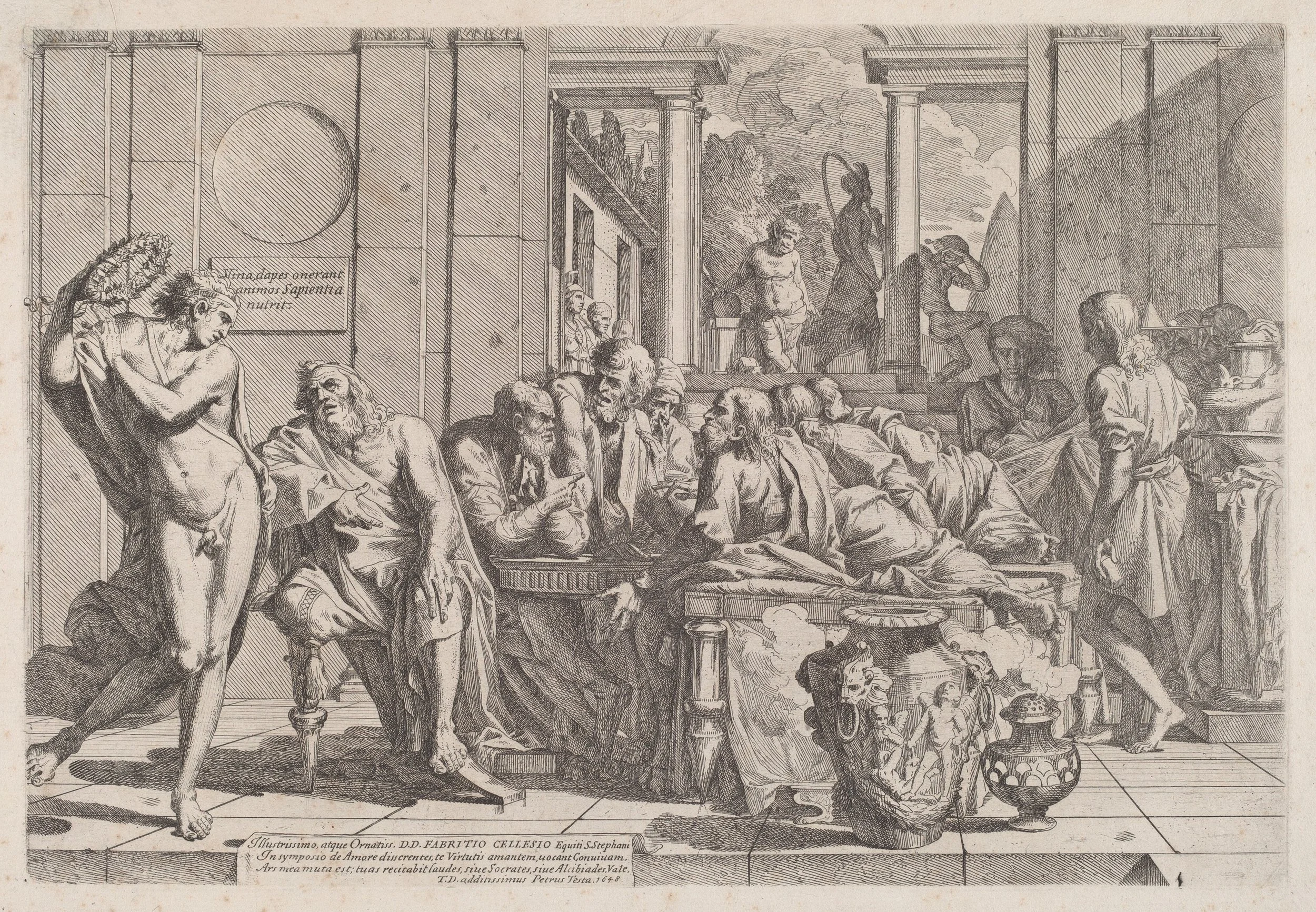
The Symposium by Pietro Testa (1648) from the National Gallery of Art
-
Text: 28b-35d
“To fear death, gentlemen of the jury, is nothing more than to believe yourself wise when you are not; it means you think you know what you don’t know. For no one knows death, whether it happens to be the greatest of all blessings, but people fear it as though they know for certain that it is the greatest of evils.” (29a-b)
Socrates quickly shows that the accusation against him is incoherent and trivial. He dismisses his accusers as motivated by slander and envy, forces that have destroyed many good people in the past and will likely ruin him as well. Socrates then redirects his speech to more important matters: he imagines a typical Athenian citizen who wonders, “Isn’t Socrates ashamed and remorseful for having pursued a lifestyle that has led him to the danger and death he faces in this trial?” Socrates replies that a good man does not consider saving his own skin, but focuses on whether his actions are right or wrong, regardless of the outcome. He quotes Homer, who is still a traditional moral authority in classical Athens, likening himself to Achilles in his courage and disregard for death. Socrates has pursued his life of philosophy with the same courage and commitment he once showed on the battlefield: just as a general stations his troops, the god has told Socrates to examine others and pursue truth, no matter the cost. It would be cowardice to back down, even in the face of danger and death.
Driving his point even further, Socrates warns that if the jury acquits him and dismisses the charges, he will never stop challenging his fellow citizens. He will always stand his ground and obey what the god has commanded him to do: urging those around him to care as much or more for the state of their souls as they do for their bodies, social standing, and material benefits. If that is “corrupting the young,” so be it. Socrates likens himself to a gadfly, who has been sent by the god to prod and arouse the great but sluggish horse that the city of Athens has become. Privately examining and challenging his fellow citizens is Socrates’ form of public service, not a life in politics. Since childhood, a “divine sign” has warned Socrates against certain actions, and he was advised long ago to avoid political life. Socrates believes he would have died long ago, if he had pursued a life in politics, leaving less time for the life he has led in pursuit of his real purpose: to exhort the Athenians about the state of their minds and souls, not merely their material goods.
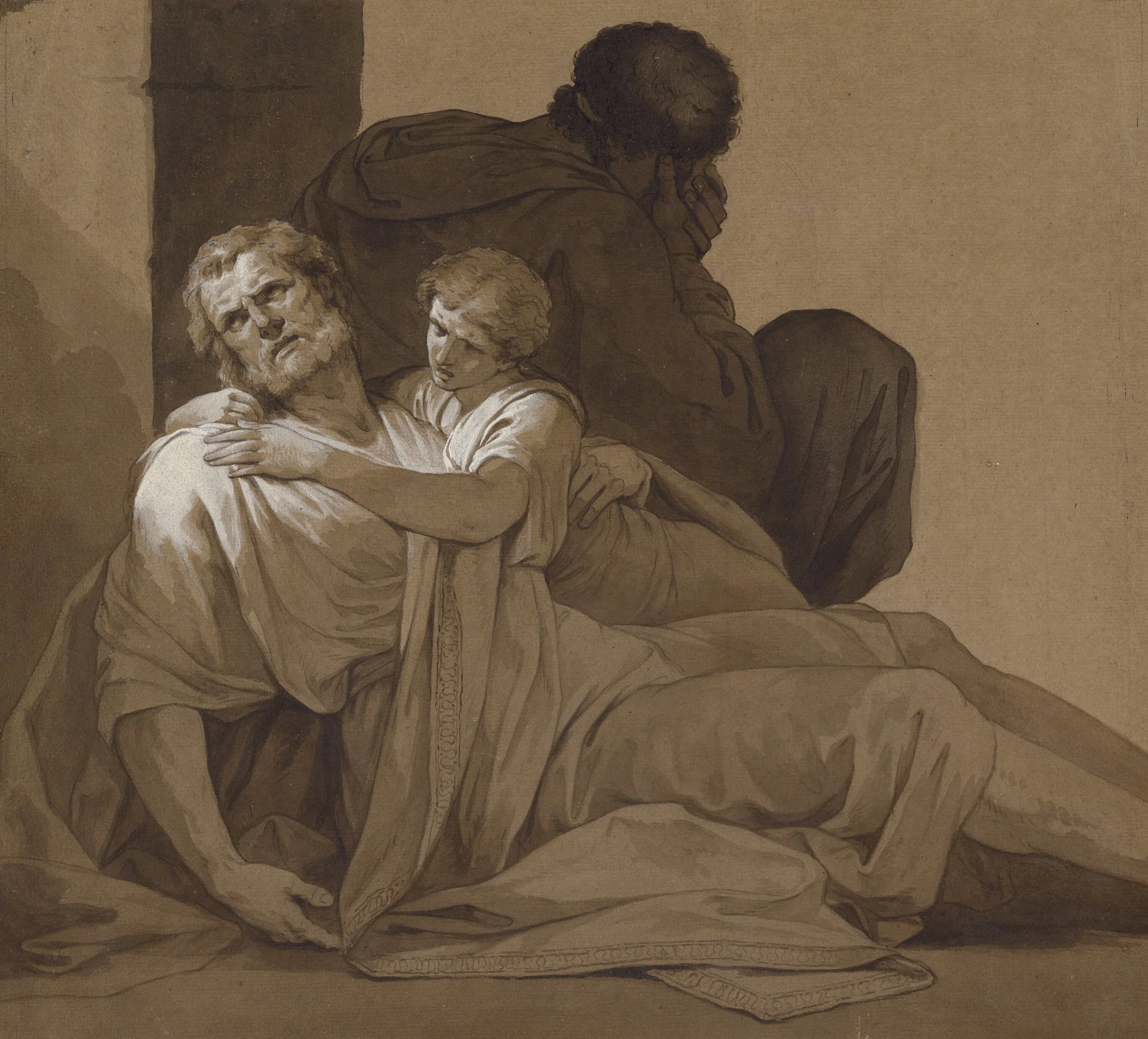
Study for the Death of Socrates by Jean-Francois-Pierre Peyron (about 1787) from the Getty Museum
-
Text: 35e-38b
“...it turns out that the greatest benefit for a human being is having daily discussions about virtue and the other matters you heard me talking about, cross-examining myself and others, for the unexamined life is not worth living for a man…” (38a)
With Socrates’ formal defense now concluded, the jury votes immediately, delivering a verdict of guilty by a margin of 60 votes (likely 280-220). In ancient Athenian law, the prosecution and defense each proposed penalties, and the jury voted on what is most appropriate. In this case, Meletus proposed the ultimate penalty of death. Socrates must in turn propose a counter-penalty, which would typically include loss of personal property or civic rights, ranging from a fine to complete exile.
Faced with the death penalty, Socrates would be expected to offer a less severe, perhaps more reasonable penalty. But in his counter-proposal (35e-38b), Socrates emphasizes that he has chosen to live a life of examination, testing and challenging those around him for the benefit of his city, while shunning the pursuit of money, status, and other goods that would have given him personal property for the jury to confiscate. He has no real assets to seize; he’s spent his life caring for his fellow citizens instead of his own wealth. Instead, Socrates proposes what he believes his actions have earned. After spending his life looking out for the character of his fellow Athenians to his own poverty, Socrates proposes that he deserves to receive free meals at the Prytaneum (City Hall) just as the city’s prize-winning athletes do. Like so many turns of phrase in the speech, this counter-proposal is meant more to teach the Athenians than anything else. Socrates is trying to communicate the value of his care for virtue and character: if Athenian athletes get free meals for championing physical prowess, how much more should Socrates deserve this for championing the souls and minds of his fellow Athenians?
Having made his point with the mock counter-proposal of free meals, Socrates goes on to consider more typical penalties. While exile might seem like a good alternative to death, Socrates explains that he simply cannot ignore his divine sign and live among some new community in silence to avoid upsetting some other Greek city as he has the Athenians. Here Socrates delivers one of the most memorable lines of the speech: the highest aim for a human being is to do exactly as he has been doing, to discuss virtue and examine one another on matters of character, “for the unexamined life is not worth living” (38a). At the close of his counter-proposal, Socrates leaves the jury with a modest option: while he could only pay 1 mina (a day’s wage for a laborer in Athens), his friends Plato, Crito, Critobulus, and Apollodorus collectively put forward 30 minas (a month’s wages) as a fine.
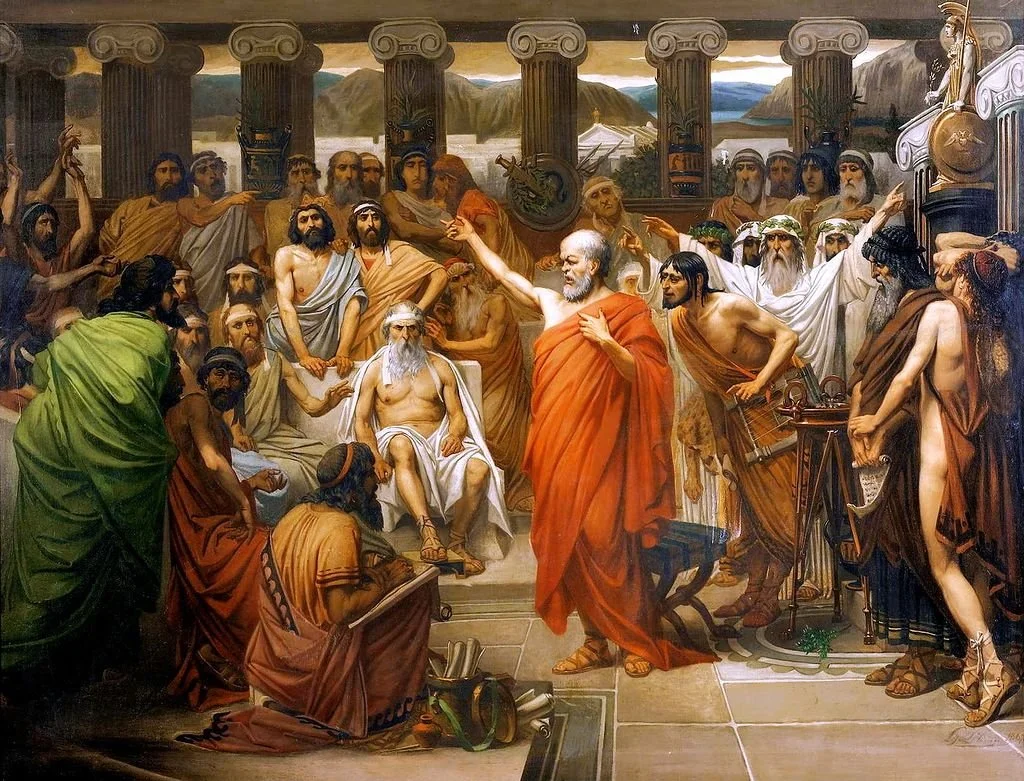
Socrates Address by Louis Joseph Lebrun (1867) from Wikimedia Commons
-
Text: 38c-42a
“And you too, judges, must keep good expectations about death and keep this one truth in mind: no evil can befall a good man either in life or death, and his concerns are not neglected by the gods.” (41c-d)
With penalties ranging from death or exile to a fine, the jury chooses death. In his final words before the jury, Socrates offers deeper reflection on mortality. His death sentence is not the worst outcome by any means. Socrates could have easily satisfied the jury, apologizing for how he had lived, and delivering the kind of speech they would have wanted to hear. But as Socrates emphasizes, it is easy to avoid death at any cost, but much harder to avoid wickedness. Socrates’ last word on the trial is that he has been condemned to death, but the accusers and those who voted to condemn him will be convicted by truth of injustice. Socrates foretells that those who voted to condemn him in the hopes of avoiding accountability for their lives will receive justice swiftly after his death: others will rise up and speak the truth.
Speaking to his friends and those who voted to acquit him, Socrates goes on to explain why his death is a better outcome than they might imagine. First, his usual divine sign has not opposed him at all; he has gone confidently into the trial knowing that he has a clear conscience about the life he has lived. Socrates then goes on to reflect that while death is unknown, it is a blessing in one of two ways. Death is either the deepest, most peaceful sleep, or it means joining others in Hades, which for Socrates would mean spending time talking with some of the greatest heroes and poets to have lived. In summary, Socrates says, a good man has no reason at all to fear death; only a wicked man. In closing, Socrates observes that he goes to die and the others go on to live, and only the god knows which is the better fate.
Thanks to Socrates’ student, Plato, the Apology is not Socrates’ final word on his remarkable life. Plato left us the Crito, a short discussion during Socrates' imprisonment, and the Phaedo, a long dialogue on the soul set in the final hours of Socrates’ life before his execution. These, along with Plato’s other works, are widely regarded as the foundation of the western philosophical tradition, probing the most profound questions of the human condition.
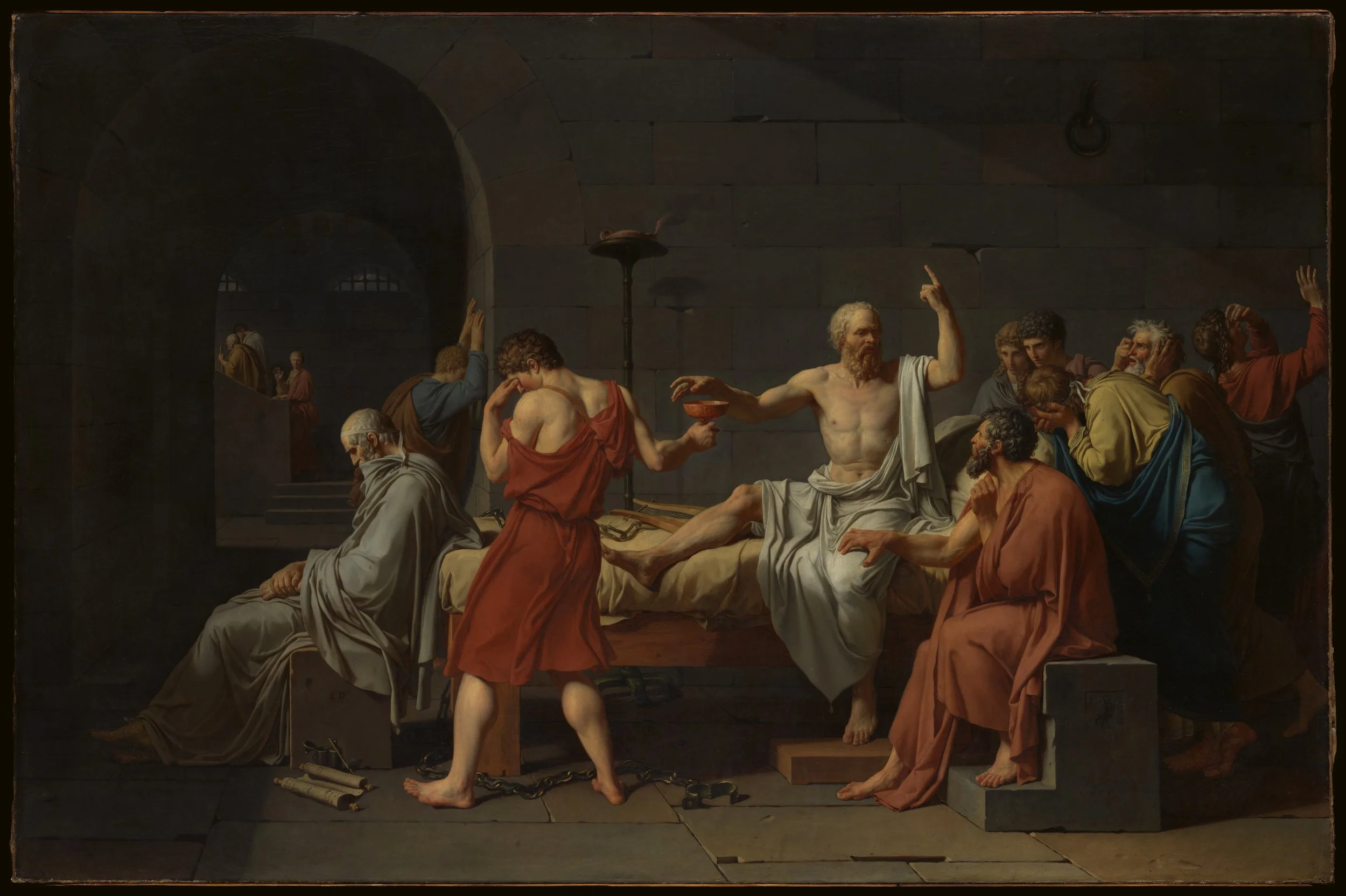
The Death of Socrates by Jacques Louis David (1787) from the Met Museum